

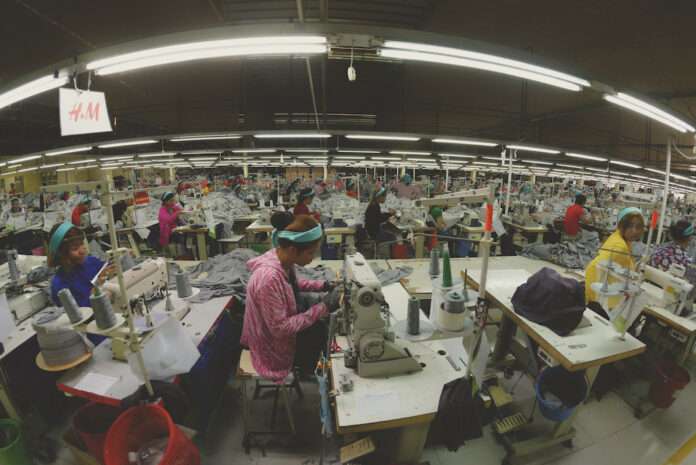
New research shows fashion brands haven’t raised supplier prices in line with inflation for 25 years — and in Bangladesh, that math has become a worker safety crisis as heat waves meet a national energy crisis.
Bangladesh relies on imports for approximately 95 percent of its energy needs, and since late April, a shortage linked to the Middle East conflict has sent the grid into rotating outages across the city’s industrial belt. What happens in the minutes that follow depends almost entirely on whether a factory can afford to run its generator: if it can, the fans resume; if it cannot — and for most of the smaller manufacturers who stitch the world’s affordable clothing, it cannot — the fans stop. In 37°C heat with high humidity, workers continue working. Some of them faint.
This is the scene behind a May 2026 investigation, which documented how the energy crisis has arrived inside Bangladesh’s garment factories. “With such distressing heat, many workers are falling sick with profuse sweating, dizziness, nausea, cramps, and fainting,” Kalpona Akter, executive director of the Bangladesh Center for Worker Solidarity, told Reuters.
A separate report, published the same month by Public Eye and Clean Clothes Campaign, contains data that explains, at least in part, why those factories have no generator budget. When adjusted for inflation, the price that fashion brands pay their garment suppliers for a basic T-shirt has declined by more than half over the past 25 years. That is largely a purchasing policy — maintained deliberately, across brands, across decades — that has systematically stripped out the margin factories might otherwise have used to invest in their facilities, their workers, or their capacity to absorb an emergency.
“The fashion brands which brag about human rights policies actively contribute to the continuation of poverty wages by their downward pricing policy,” Kalpona Akter, president of the Bangladesh Garment and Industrial Workers Federation, said in a statement accompanying the Public Eye release. “Higher prices are needed for living wages, safe workplaces, and sustainable production.”
Akter has spent three decades in the garment industry, first as a factory worker and later as one of its most prominent advocates, and what the Public Eye research establishes is not new to her — only more precisely documented. The report covers 25 years of sourcing data and finds that price suppression is structural: brands use competition among suppliers to keep unit costs at levels that have never accounted for inflation, let alone for genuine improvements in wages or working conditions.
The Bangladesh Institute of Labour Studies supplied the human dimension earlier this year in a survey of 215 garment workers, finding that 78 percent had experienced greater summer heat at their workplaces and that roughly half described the heat as making them physically weak or ill.
The figure that best captures the scope of the problem comes from Lancet Countdown research: 29 billion labor hours were lost in Bangladesh to heat exposure in 2024 alone, a 92 percent increase over the average from 1990 to 1999. Bangladesh is not a marginal supplier to global fashion. It is the world’s second-largest garment exporter, producing roughly $40 billion worth of clothing annually for brands that include nearly every major name in Western retail. Those brands set the prices. Those prices set the conditions. Those conditions — underfunded factories with no generator reserve and no cooling budget — are now meeting a climate event that grows more severe each summer.
The Middle East conflict added a new variable to a system that had no remaining slack. Because Bangladesh imports nearly all of its fuel, the disruption to regional energy supplies drove costs sharply upward as Dhaka’s temperatures peaked for the season. The factories most exposed were the smallest ones, operating on the thinnest margins, which are also the ones most likely to be producing at the price points that fast fashion brands favor most.
The Public Eye report does not name specific brands, but its methodology covers the sourcing practices that collectively account for the majority of global garment production. The conclusion is not that a few companies are bad actors but that the business model itself — in which the cost of responsible production is treated as the supplier’s problem rather than a shared obligation — has built a system with no capacity to absorb shocks. When the grid fails and the temperature climbs, there is no float. There is only the heat.
This matters beyond Bangladesh; the same dynamic applies across the garment-producing countries serving Western markets: Cambodia, Sri Lanka, India, Indonesia. Bangladesh is where it is most visible right now because the energy shortage, the heat, and the existing documentation of working conditions have converged into something that cannot be separated into its component parts.
Some advocates argue that mandatory living wage legislation is the necessary intervention. Others point to extended producer responsibility frameworks that would force brands to account for the labor and environmental costs they currently externalize. What the data makes clear is that voluntary commitments have not moved the pricing. Brands have issued sustainability reports, signed frameworks, and expressed concern about supply chain conditions across two full decades. The inflation-adjusted price of a T-shirt kept falling anyway.
In Dhaka, when the power returns, the fans start again. Workers who had been pressing damp cloths against their necks or leaning against the walls for support return to their machines. The price the factory receives for what it makes has barely changed since the late 1990s, and there is no indication from the brands that set it that it will change now. And the heat will most likely be even worse next year.
Related on Ethos:
