

Sunday, January 18, 2026

Bentley Releases Its First Sustainability Report: ‘We Aim to Become the World’s Benchmark’

Share

Luxury automotive company Bentley Motors has released its inaugural Sustainability Report and announced the launch of the Bentley Sustainability Council.

On its continuing mission to become a sustainability leader in the automotive sector, Bentley Motors has launched two key initiatives: its first-ever Sustainability Report and the Bentley Sustainability Council. Both align with the British automaker’s Beyond100 sustainability strategy.

“We aim to become the world’s benchmark luxury car business, a leader in Sustainable Luxury Mobility, that is resilient for every challenge we encounter,” Adrian Hallmark, Chairman and CEO of Bentley Motors, says in the report.

“Whilst we continue to address the vital climate and societal challenges we face
today, we have maintained our place as the most sought-after Sustainable Luxury
Mobility brand, the foundations of which have been built over the last 102 years,” Hallmark said.

“This places us in a stronger position than ever before to engage in the innovation and collaboration required to become the leader in Sustainable Luxury Mobility. It is no small task, but we are not frightened by it, we are inspired by it,” Hallmark wrote.

Bentley electric car
Courtesy Bentley

Through the Sustainability Report, Bentley highlights the roadmap to achieving its goals and initiatives implemented throughout its value chain, notably at its historic Crewe campus and in its latest range of luxury cars.

The company’s commitment to sustainability is demonstrated by a £2.5 billion, ten-year sustainability investment program announced in 2022. This program focuses on future products and the transformation of Bentley’s Pyms Lane factory in Crewe, where all Bentley models are handcrafted, including the production of the next generation of all-electric cars.

The report notes the automaker will offer plug-in hybrids in all models from 2024, working toward transitioning to all BEV models by 2030 and end-to-end carbon neutral by the end of 2030. “We have made sure our strategy can adapt to any material changes, whether internal or external, whilst staying focused on our vision and purpose,” reads the report.

The company’s commitment to sustainability has also resulted in a rise in operating profits by nearly €1 billion in five years, reaching €708 million.

Hallmark expressed the company’s commitment to transparency and its pursuit of a more sustainable future. “The report will be an annual publication, highlighting our progress as we move towards our Beyond100 targets,” Hallmark said. He further emphasized the importance of the newly established Sustainability Council. “The new established Sustainability Council will challenge our progress and aids our mission to become the global  leader in sustainable luxury mobility.”
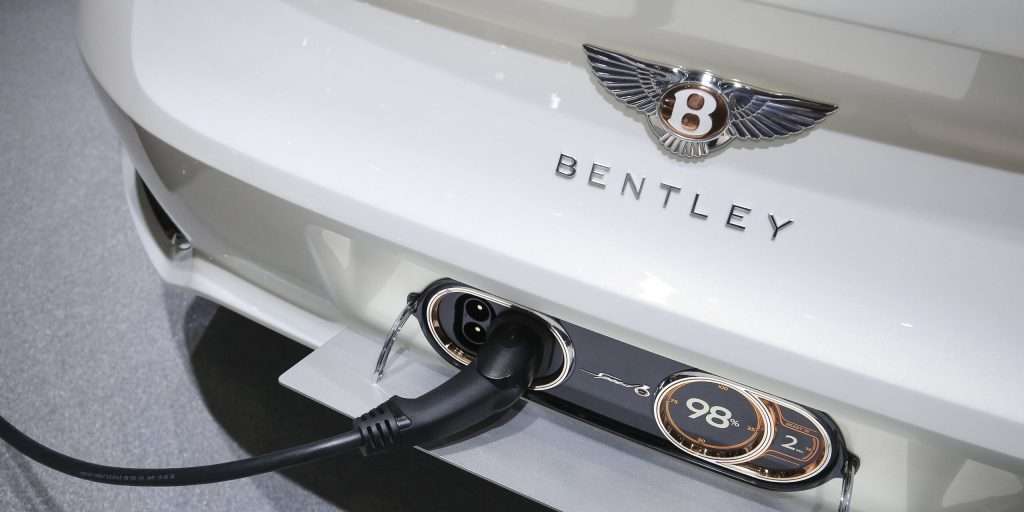
Bentley charging point
Courtesy Bentley

The Bentley Sustainability Council comprises three experts who will accelerate Bentley’s sustainable journey: Dr. Sally Uren, OBE, Chief Executive of Forum for the Future; Dr. Andrew Dent, EVP of Materials Research at Material ConneXion; and Dr. Nicholas Garrett, Co-founder and Director of RCS Global Group.

Serving as an external voice, the Council will bring fresh ideas that challenge and encourage the Beyond100 strategy, which aims to achieve end-to-end carbon neutrality by 2030. Working directly with the Bentley Board of Management and the Sustainability Committee, the Council will play a crucial role in guiding the automotive industry through one of its most significant transformations.

The launch of the Sustainability Council and the publication of the Sustainability Report coincide with Bentley’s record-breaking sales year in 2022; the brand’s sales of more than 15,000 cars represented a four percent growth compared to the previous year. Bentley says the sales increase was driven by new model introductions, increased demand for Mulliner personalization, and Bentley’s expansion of hybridized models.

Related on Ethos:

Related

How L’Oréal Is Testing Sustainable Innovation at Scale

L’Oréal has revealed the first cohort for L’AcceleratOR, its €100 million sustainable innovation program, selecting 13 companies focused on packaging, ingredients, circular systems, and emissions data. The group was chosen from nearly 1,000 applicants and represents the first pilot phase of the five-year initiative, which is designed to identify, test, and potentially scale sustainability-focused technologies across the company’s global operations and the wider beauty industry. https://www.loreal.com/en/press-release/sustainable-development/-l-oreal-announces-the-first-13-change-makers-chosen-to-join-its-eur-100-million-sustainable-innovation-l-accelerator-program/ Launched in 2024, L’AcceleratOR was created to move beyond concept-stage innovation and toward commercial deployment, with a particular emphasis on solutions that can be piloted within existing industrial systems. The program is operated in partnership with the University of Cambridge Institute for Sustainability Leadership, which is overseeing a structured support phase centered on pilot readiness and business integration. https://www.cisl.cam.ac.uk/ Rather than narrowing its scope to a single sustainability challenge, L’Oréal has positioned the accelerator around a broad set of operational priorities, including low-carbon materials and energy, nature-sourced ingredients, water resilience, the reduction of fossil-based plastics, circular manufacturing processes, and inclusive business models. The composition of the first cohort reflects that approach, with selected companies spanning physical materials, chemical inputs, waste transformation, and digital infrastructure. https://www.esgtoday.com/loreal-backs-13-climate-nature-and-circularity-solutions-startups/ Packaging, Materials, and the Push Away From Fossil Inputs Several of the selected companies focus on rethinking packaging formats that remain deeply embedded in beauty supply chains. United Kingdom-based Pulpex is developing recyclable paper bottles intended to replace rigid plastic packaging, while Japan’s Bioworks produces bioplastics derived from sugarcane and other plant-based feedstocks. Sweden’s Blue Ocean Closures and PULPAC are advancing fiber-based packaging systems designed to reduce both material complexity and carbon intensity, and Estonia’s RAIKU transforms natural wood into protective packaging alternatives traditionally made from petroleum-based foams. https://esgpost.com/loreal-selects-first-13-start-ups-for-laccelerator-sustainability-programme/ Ingredients and formulation inputs are also central to the cohort. France-based Biosynthis focuses on renewable and biodegradable raw materials, while U.S. company P2 Science applies green chemistry principles to develop bio-sourced fragrance and ingredient components. Another U.S. firm, Oberon Fuels, converts wood and pulp waste into renewable dimethyl ether suitable for aerosol formulations, addressing a category that has historically relied on fossil-derived propellants. https://esgpost.com/loreal-selects-first-13-start-ups-for-laccelerator-sustainability-programme/ Circular Systems and Measuring What Matters Circularity solutions appear throughout the cohort, including Belgium’s Novobiom, which uses fungi to break down complex waste streams into higher-value materials, and France’s REPLACE, which has developed a single-step process to convert multi-layer waste into new durable products. From Brazil, Gàs Verde contributes biomethane production technology aimed at reducing fossil fuel use in industrial energy and transport. https://esgpost.com/loreal-selects-first-13-start-ups-for-laccelerator-sustainability-programme/ The only data intelligence company selected, United Kingdom-based Neutreeno, focuses on supply-chain emissions measurement and reduction, reflecting the growing role of digital infrastructure in meeting climate targets and regulatory expectations. https://www.esgtoday.com/loreal-backs-13-climate-nature-and-circularity-solutions-startups/ The thirteen companies will now enter a CISL-led support phase focused on pilot readiness, with opportunities to run six- to nine-month pilots and, if successful, scale solutions across L’Oréal’s operations. Ezgi Barcenas, Chief Corporate Responsibility Officer at L’Oréal, described the approach as intentionally collaborative, saying, “To accelerate sustainable solutions to market, we are being even more intentional and inclusive in our pursuit of partnerships through L’AcceleratOR. We are really energized to be co-designing the future of beauty with CISL and these 13 change-makers.” https://www.esgtoday.com/loreal-backs-13-climate-nature-and-circularity-solutions-startups/ L’AcceleratOR sits within the company’s broader ten-year sustainability strategy, which includes goals to reach one hundred percent renewable energy, source at least ninety percent bio-based materials in formulas and packaging, reduce virgin plastic use by fifty percent, and significantly cut Scope One, Scope Two, and selected Scope Three emissions by 2030. https://www.loreal.com/en/commitments-and-responsibilities/

Secondhand Nike, Ugg Outpaced Traditional Sneaker Growth In 2025

StockX data show comfort silhouettes from Nike and Ugg delivered the fastest growth on the secondhand market.

Why Elton John Put His Name on a Zero-ABV Celebration Bottle

Elton John Zero is here, and it’s a sparkling zero percent ABV bottle with a very Elton reason.

Dior Is Bringing a 19,000 Square-Foot Green Space to Tokyo

Dior’s Bamboo Pavilion opens in Tokyo with an expansive indoor garden, blending fashion, landscape design, and Japanese craftsmanship in a new retail concept.

Ralph Lauren Invests in Domestic Fashion as U.S. Manufacturing Job Market Shrinks

The Council of Fashion Designers of America is widening its financial commitment to domestic apparel production as new economic data underscore just how fragile American fashion manufacturing has become.