


Iconic Castile soap brand Dr. Bronner’s has announced a recyclable carton soap refill to help reduce its plastic footprint.
Leading North American natural soap brand, Dr. Bronner’s, has unveiled a 32 oz. pure Castile liquid soap refill carton. This initiative is a part of the family-owned company’s ongoing mission to cut down on plastic production and consumption.
The newly launched carton reduces plastic use by 82 percent compared with its signature plastic bottles, according to the company. The refill cartons cater to cleaning requirements and personal care, allowing customers to refill existing containers.
Dr. Bronner’s has long been a trailblazer in sustainable packaging, having implemented the use of post-consumer recycled (PCR) plastic for its liquid soap packaging more than a decade ago, making it one of the first American companies to adopt such measures. “We created our Pure-Castile Liquid Soap Refill Carton to reduce the number of plastic bottles we put into the world,” David Bronner, Cosmic Engagement Officer (CEO) of Dr. Bronner’s, said in a statement. “We’re proud that we created a substantial end market for PCR plastic.”
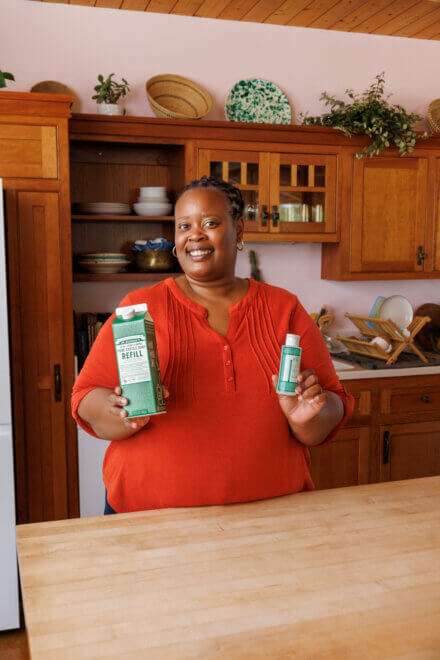
Bronner says that the ideal recycling rate for plastic bottles in this country would be close to 100 percent. “Unfortunately, the rate is closer to 30 percent, and disposal of plastic packaging in landfills is not sustainable,” Bronner said. “We commissioned a life cycle analysis looking at what packaging material was most ecological to package our refill offering in: paper carton vs. aluminum vs. glass vs. plastic. The paper carton performed the best on every relevant ecological impact measure even when accounting for the recycling rates of each material, nationally.”
The refill carton, primarily composed of paper, has been engineered to reduce the overall plastic footprint. It is designed to facilitate the refilling of PCR plastic bottles, which can be used repeatedly. The carton’s composition is 69 percent Forest Stewardship Council-certified paper, 5 percent aluminum, and 26 percent polyethylene, with a polypropylene cap. A thin interior plastic lining replaces the wax lining typically used in juice or plant-based milk cartons, which is degraded by soap, thereby minimizing the total plastic requirement.
Emphasizing the company’s earth-friendly ethos, Michael Bronner, President of Dr. Bronner’s, said both the company and its customers are very eco-conscious. “We seek to ‘Treat the Earth Like Home’ in all we do,” he said. “This new packaging is a crucial step in addressing our plastic use as a company. This year is the 75th anniversary of my grandfather founding the company, Bronner said. While we have so much history to celebrate — we are also looking to the future by improving our packaging. It is imperative that we reduce our collective use of plastic on Earth.”
The company’s innovative products and its social and environmental commitments have made it the top-performing natural soap brand. Bronner’s generated nearly $170 million in revenue in 2021 and donated an estimated one-third of profits to activist and charitable efforts. The company has been an outspoken advocate for sustainable and ethical ingredients. It supports a number of notable causes including fair labor, animal welfare issues, and the legalization of psychedelic substances.
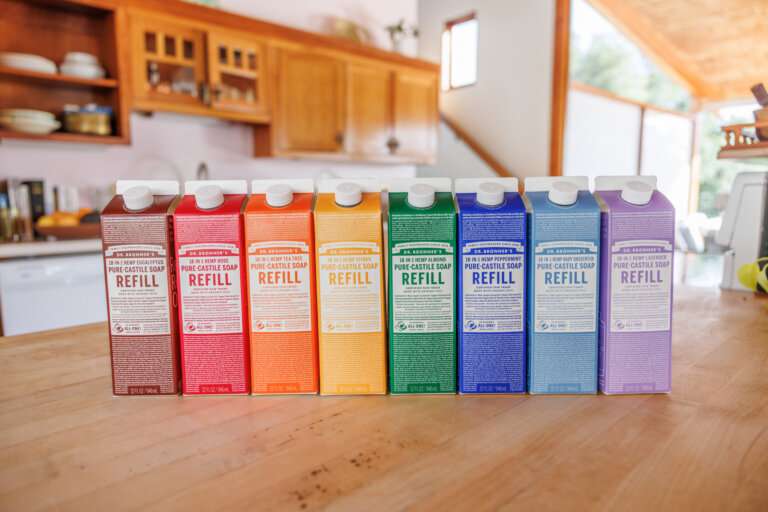
Dr. Bronner’s Pure-Castile Liquid Soap Refill Carton is available online and at select retail locations. More information about its use and ecological impact can be found on the company’s website. The product comes in eight fragrances, with an MSRP of $16.99.
Related on Ethos:
