

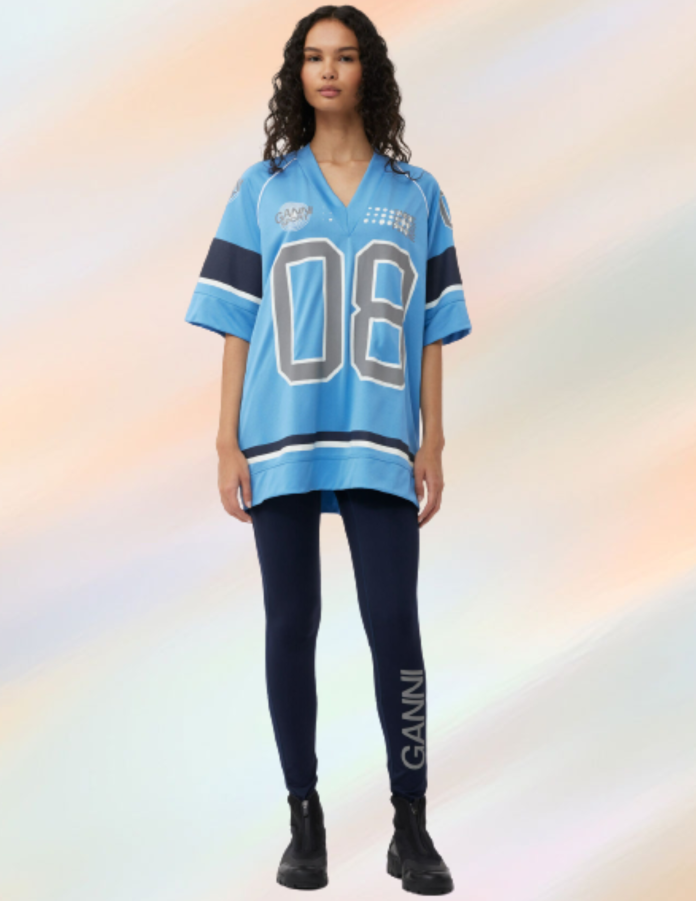
Ganni, the Danish label known for its accessible luxury, is collaborating with the Los Angeles-based Ambercycle, a pioneer in circular material innovation.
As part of Ganni’s Fabrics of the Future initiative, the label is embarking on a new partnership Ambercycle and its recycled Cycora material. The new material features in an oversized shirt in Ganni’s new sports collection.
This newly forged alliance exemplifies the convergence of two brands with a shared dedication to environmental stewardship and innovation. The use of Cycora contributes to Ganni’s goal of slashing its carbon footprint by half by the year 2027 and ensuring that ten percent of its materials stem from its Fabrics of the Future initiative by 2025.
“Since 2019, we have been working hard to move away from conventional materials and switch to better alternatives,” Ganni’s Sustainability & CSR Director, Lauren Bartley, said in a statement. “Investing in innovative low-carbon materials is crucial to making fashion more responsible and partnering with Ambercycle brings us one step closer to that ambition. Ambercycle is one of the front runners when it comes to recycling of post-consumer waste within polyester fibers — which is also one of the reasons why we choose to support and partner with Ambercycle through our ‘Fabrics of The Future’ initiative.”

Ambercycle, since its inception in 2015, has been at the forefront of propelling the fashion industry toward a circular economy. The company’s groundbreaking molecular regeneration technology produces Cycora from end-of-life textiles. By redefining the industry’s approach to raw material usage, Ambercycle is setting a benchmark for environmentally conscious material production.
Shay Sethi, Ambercycle’s co-founder and CEO, applauded Ganni’s commitment. “Ganni’s comprehensive approach to responsible brand-building is completely aligned with our vision for what the future of fashion can look like. Our collective aim is to bring circular products to market quickly and drive systemic change urgently needed in the fashion industry. This partnership marks a pivotal step in our journey to scaling the production and widespread adoption of circular materials.”
Ganni’s responsible ethos extends to its operational and creative aspects, with the Copenhagen-based fashion house embracing its B Corp certification and active engagement in carbon insetting within its supply chain. The annual Responsibility Report by Ganni marks its transparent progress tracking and its resolute goal for a 50 percent absolute carbon reduction by 2027.
The brand’s commitment to eco-consciousness is evident in its pledge to exclusively select certified recycled, organic, or low-impact fabrics for its future collections and its initiative to cease the use of virgin animal leather in its ready-to-wear line, extending to shoes and accessories by 2023. With a robust traceability system in place for its supply chain, Ganni stands as a paragon for transparency in the fashion industry.
The news comes as Drive Catalyst, the venture capital arm of the Far Eastern Group, has announced a $5 million investment in Ambercycle to help the startup scale its textile-to-textile regeneration.
“Textile-to-textile regeneration will be crucial in shifting to a fossil-free fashion industry,” Juliana Pidner Hsu, managing director of Drive Catalyst said in a statement. “However, the production infrastructure must be scaled to fulfil the business requirements of large fashion brands and their customers. With Ambercycle as a partner, we can make significant strides forward.”
According to Sethi, Ambercyle has a deep conviction in circularity and the commercial viability of Cycora. “For circularity to scale, integration across the entire value chain is essential.”
Related on Ethos:
