

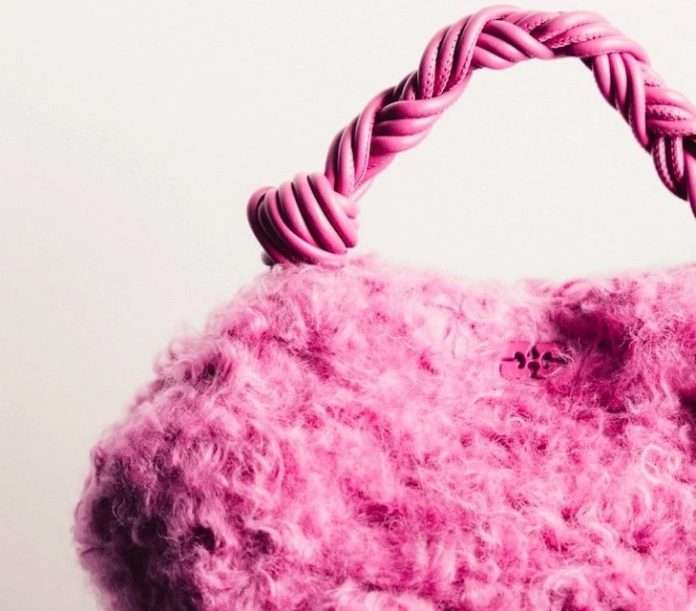
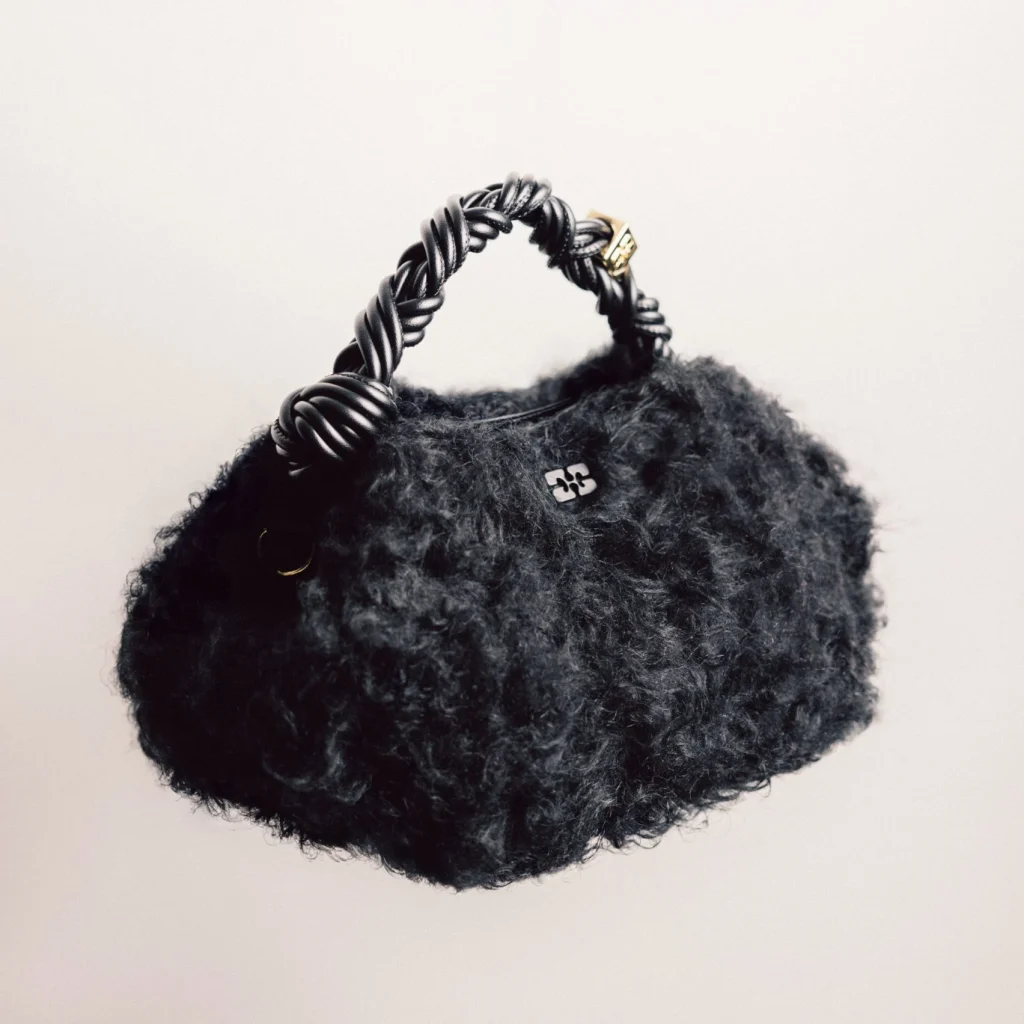
Keeping to its sustainable textiles commitments, Danish luxury label Ganni has debuted bags made from BioFluff vegan fur.
During its Copenhagen Fashion Week show, Ganni showcased its latest sustainable material partner: BioFluff. The luxury label used the plant-based fur developed by the New York- and Paris-based materials tech company that claims it created the “world’s first plant-based fur,” made from an eco-friendly blend of nettle, hemp, and flax fibers.
Ganni’s BioFluff bags come in a range of colors — from natural brown to vibrant pink and black — each also featured recycled leather handles. The BioFluff fur is not only a departure from traditional fur, but also most faux furs that rely on plastics and petrochemicals. BioFluff uses what it says is a groundbreaking enzymatic process that transforms plant and agricultural waste fibers into a luxe, plastic-free fur alternative. While the company has yet to conduct a formal compostability study on its faux fur, BioFluff says the fur is designed to decompose in industrial composting facilities within several weeks.
“We source the fibers in Europe and create the fur in Italy using our patented process,” BioFluff co-founder and CEO Martin Stübler, said in a statement. Stübler says the efficiency and eco-friendliness of the company’s production allows the fur ‘hairs’ to be from genuine plant fibers, “meaning we do not process the fibers into yarn, which avoids the energy-intensive yarn spinning process,” he said. This approach not only reduces the environmental impact but also maintains the authenticity and quality of the materials.
Early estimates by BioFluff indicate a dramatic reduction in emissions, with the plant-based fur producing up to 90 percent fewer emissions than its real fur counterparts and 50 percent fewer than plastic faux fur. This reduction is attributed to the elimination of the need for livestock and the extensive processing that animal pelts require, as well as the avoidance of microplastic issues associated with synthetic furs.
Ganni’s exploration of sustainable materials extends beyond BioFluff, as demonstrated at the Future, Talent, Fabrics exhibitions. The label also highlighted emerging Nordic designers and introduced its partnership with Polybion, which produces Celium, a bacterial-grown leather alternative. These efforts align with Ganni’s ambitious goal to halve its emissions by 2027, showcasing a variety of sustainable materials including banana waste yarn.
The news comes as BioFluff closed a $2.5 million Seed funding round last month led by agrifood tech investor Astanor Ventures.
“At the close of this seed round with best-in-class impact investors, we are poised to scale our unique approach to reducing reliance on animal and synthetic-derived products in the textile industry,” Steubler said. “This investment will accelerate our mission to provide brands with better materials for a cleaner future.”
Related on Ethos:
