


Stella McCartney is back at the United Nations Climate Change Conference calling on world leaders to hold the fashion industry more accountable for its carbon footprint. And she’s bringing proof a more sustainable way is possible.
While COP28 is facing scrutiny over the heavy presence of fossil fuel and animal agriculture industries, designer Stella McCartney is bringing a glimmer of hope to the fashion sector with the Stella McCartney’s Sustainable Market: Innovating Tomorrow’s Solutions, on display through December 12. Like the designer’s materials market pop-up at Paris Fashion Week in September, McCartney is spotlighting several groundbreaking materials that could help the industry reduce its carbon footprint.
“I’m here at COP28 to represent the world of fashion,” she said at the event, calling the fashion industry “one of the most harmful” industries in the world. Fashion produces about ten percent of global emissions.
“And I think the leaders in the business of fashion are literally getting away with it because they don’t have any laws. So I think they don’t really have to be here. They’re not being called out. So I’m kind of calling out my own industry, but I’m doing it in a way where I’m trying to encourage and provide a solution. So there is a positive end to the story, I think,” the British designer said.

To support her position, the designer has brought innovative materials to her showcase. She debuted the first garment made from biological recycling earlier this week. She also partnered with Keel Labs on its flagship product, Kelsun — a seaweed-based fiber made from 75 percent kelp.
“In my recent Summer 2024 runway show, we worked with the visionaries at Keel Labs on a seaweed-based yarn, Kelsun, grown from renewable and regenerative kelp that uses the ocean’s resources to protect it,” McCartney. said in a statement “This could also offer a planet-friendly alternative to cotton, which accounts for 2.5 percent of the world’s arable land and 16 percent of all pesticide use. Kelsun uses 70 times less water than conventional cotton, and 100% less land and pesticide use. This is the future of fashion.”
The latest product launched by the designer is faux fur from Italian label Savian. It produces an entirely plant-based and plastic-free fur. Utilizing a blend of traditional craftsmanship and modern biotechnology, the new material is crafted from natural elements including cellulose, hemp, and linen.
According to McCartney’s website, the fur industry is responsible for the demise of over 100 million animals annually. These animals, either bred on farms or trapped in the wild, face prolonged suffering. Moreover, synthetic fur options contribute to environmental degradation by releasing microplastics into ecosystems, affecting both wildlife and humans.
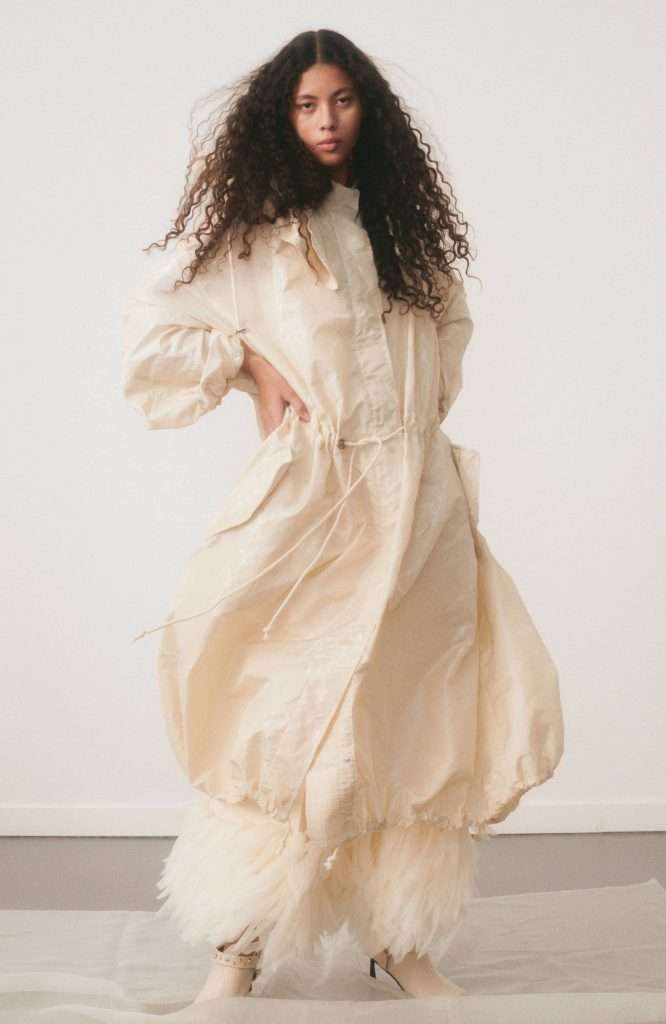
Savian’s product replicates the texture and feel of animal fur by combining advanced technology with plant-based materials like cellulose, hemp cellulose, and linen. This innovative approach fosters a deep, nature-connected sensory experience, the designer says. Savian’s material is also derived from GMO-free plant sources. Notably, about half of these materials can be obtained from agricultural waste. Compared to high-quality synthetic furs, Savian’s production process emits significantly less carbon dioxide, reducing emissions by 40 to 90 percent.
“Looking at a fur coat in a glossy magazine, you might not realise the terribly sad story behind it,” reads McCartney’s website. “Often, fur farmers will use the cheapest and cruelest methods of ‘harvesting’ fur available. Savian’s mission is to create a true partnership with nature through their material: one 100 percent plant-based, where there is only love and respect for both animals and nature.”
The designer is also working with a range of leathers made from alternative materials as part of a $200 million sustainable investment fund she co-founded. “I think you’ve got to put your money where your mouth is and you’ve got to give these people funding to replace bad business for good business,” the designed said.
“And then I’m also here to try and talk to policymakers and to try and have some kind of legal parameters in the world of fashion so that our industry, so that all of the other industries here, actually have some kind of laws in place so that we can be more environmentally friendly.”
Related on Ethos:
