

Tuesday, January 20, 2026

Who Gives A Crap: Toilet Paper On a Mission

Share

who gives a crap sponsor banner

Toilet paper gets an eco, mood-boosting upgrade with Who Gives A Crap’s newest collection.

Going to the bathroom — it’s a mood, right? We go, most often, because we need to go. But we also head to the water closet sometimes for a break — an introvert’s respite from a crowded event, maybe it’s for a bit of grooming, or to gather our thoughts before a big meeting, a first date, a breakup.

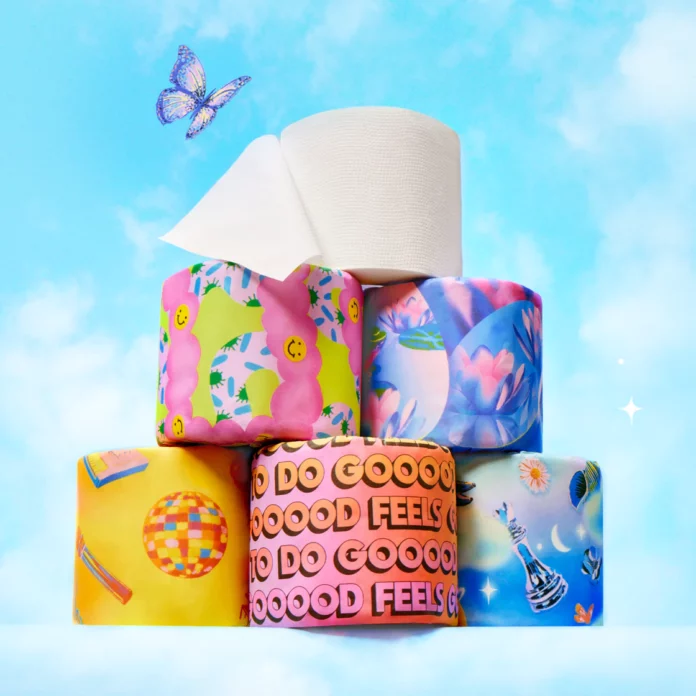
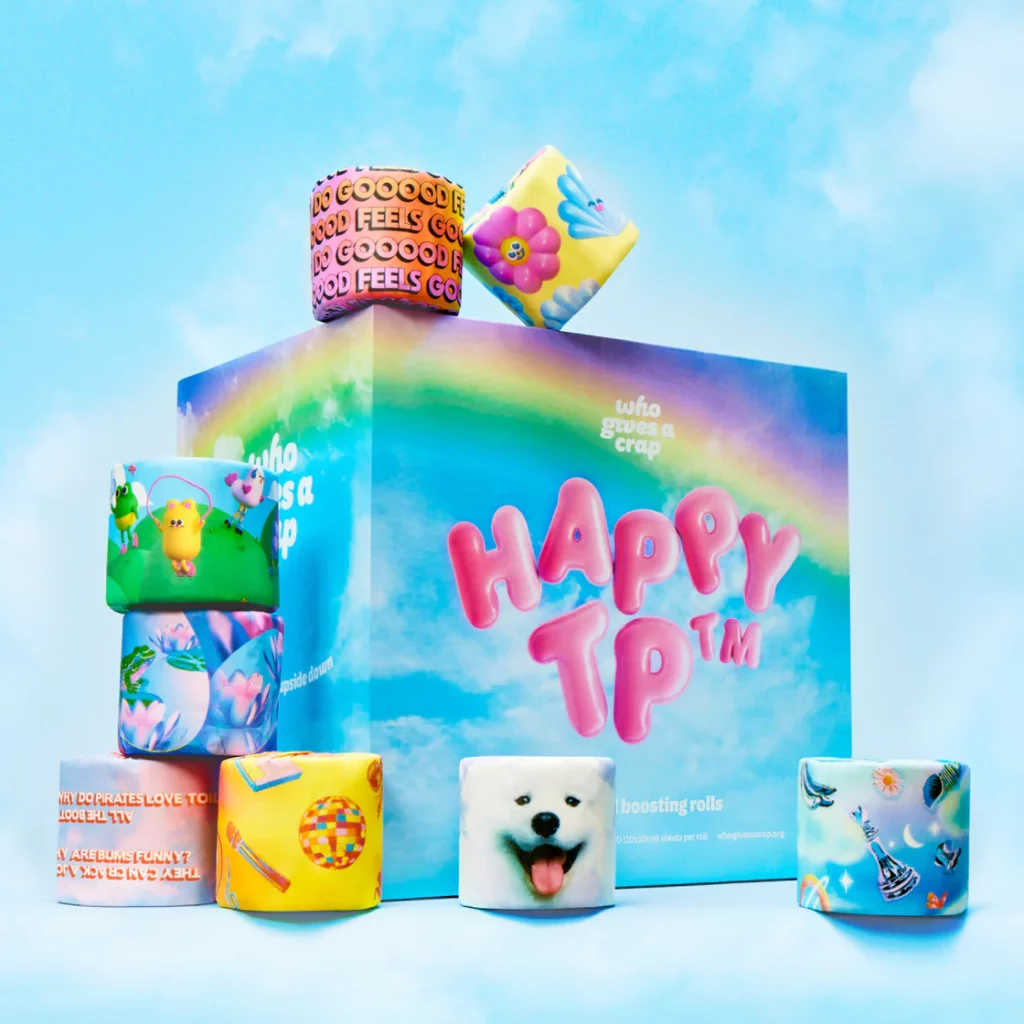
Whatever the reason may be, we all go to the bathroom. And sustainable bamboo and recycled paper toilet paper brand Who Gives A Crap is hoping to make that bathroom visit a little bit more meaningful and a whole lot less stressful, with the launch of what it says is the world’s first mood-boosting toilet paper collection, Happy TP.

Mood-boosting toilet paper

Who Gives A Crap has launched a limited edition artists-designed collection in an effort to help you feel good on (and just generally near) the toilet. The box features 12 unique and science-backed designs from happy dogs and rainbows to affirmations — all aimed at giving your mood a boost. 
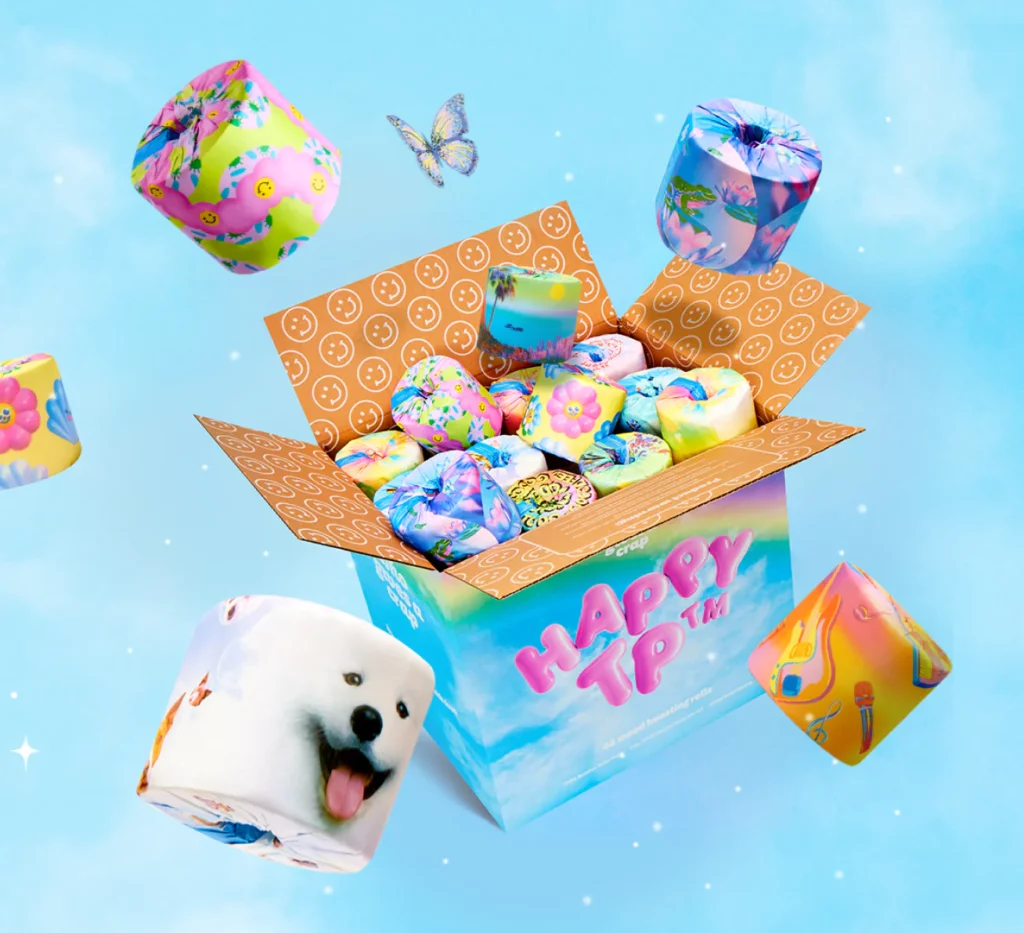
Who Gives A Crap's mood-boosting toilet paper
Who Gives A Crap’s mood-boosting toilet paper | Courtesy

Who Gives A Crap says it partnered with a roster of artists, which includes Lily Fulop, Izzy Lawrence, Melissa Mathieson, Mischelle Moy, Gretchen Schwartz, and Tyler Spangler because they’re known for their dopamine-inducing designs. There’s Spangler, who designed the Laughter, Smile, and Altruism wrappers, as well as Lawrence and Mathieson who visualized the concepts of Meditation, Music, Sleep, Confidence, and Exercise. 

“When we laugh, we swap out the cortisol (or stress hormone) in our bloodstream with feel-good chemicals like dopamine, oxytocin, and endorphins,” Who Gives A Crap told Ethos via email. And the company says designing a wrapper with jokes to get people chuckling is a surefire way to boost their moods while they sit on the loo.

Toilet paper’s dirty secrets

There’s more reason than ever to want to make your bathroom trip a bit, well, lighter. That’s because the environmental impact of conventional toilet paper is pretty (ahem) shitty.

According to recent data, the U.S. uses more toilet paper than any other country in the world. On average, every American will use a whopping 141 rolls per year. In most cases, this paper comes at the expense of virgin trees, namely from Canada’s critically important boreal forests. In fact, toilet paper production is a leading cause of deforestation, with more than one million trees cut down for toilet paper worldwide every single day. 
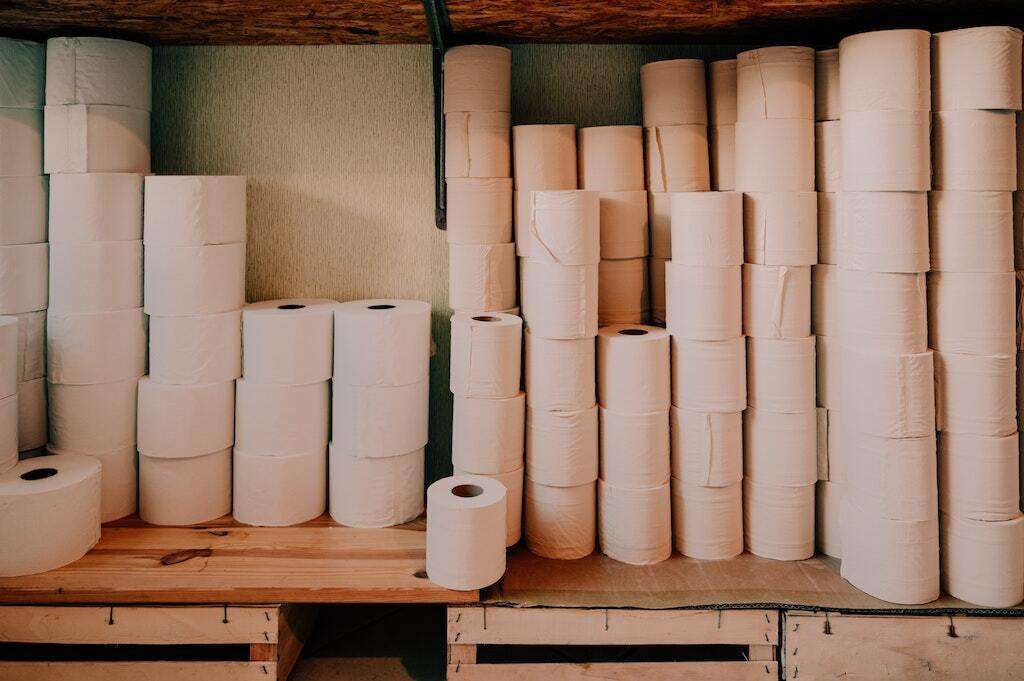
toilet paper
Photo courtesy Konstantin Volke

It’s not just forests that suffer as a result of our toilet paper dependency. When it comes to conventional toilet tissue, there’s a huge amount of plastic waste involved, too. The numbers are tricky when it comes to plastic wrap waste, but according to the OECD (Organization for Economic Co-operation and Development), nearly 60 percent of plastic waste is generated by plastics with a lifetime of less than five years. Forty percent comes from packaging and 12 percent is from the consumer goods industries. 

So let’s do a little math (another fun way to pass the time on the toilet) at 141 rolls per person per year, that’s more than 23 six-packs of toilet paper a year all wrapped in plastic film. Multiply that by every person in the U.S. and that’s nearly 9 billion six-packs of plastic-wrapped toilet paper every single year. (Holy. Crap.)

Who Gives A Crap doesn’t wrap its rolls in plastic, it uses tissue paper printed with eco-friendly soy inks instead. It’s more sustainable and looks a lot nicer, too.

Just like those other industries linked to deforestation (chiefly beef, dairy, soy, and palm oil), and those tied to the global plastic waste problem, there are alternatives to conventional toilet paper. No, we don’t mean you need to run out and buy a bidet — although it’s not a bad idea. 
bathroom
Photo courtesy Hemant Kanojiya

But here’s the thing: even with bidets in every home, toilet paper is still a really important commodity. It’s kind of hard to imagine a world without toilet paper, isn’t it?

Unlike the challenges that come with switching from beef or palm oil to more sustainable solutions, making the shift from virgin toilet paper to bamboo or recycled is incredibly easy. All you have to do is choose the more sustainable product — and in the case of Who Gives A Crap, you just have it delivered straight to your door every month (with free, carbon neutral shipping). 

Toilet paper on a mission

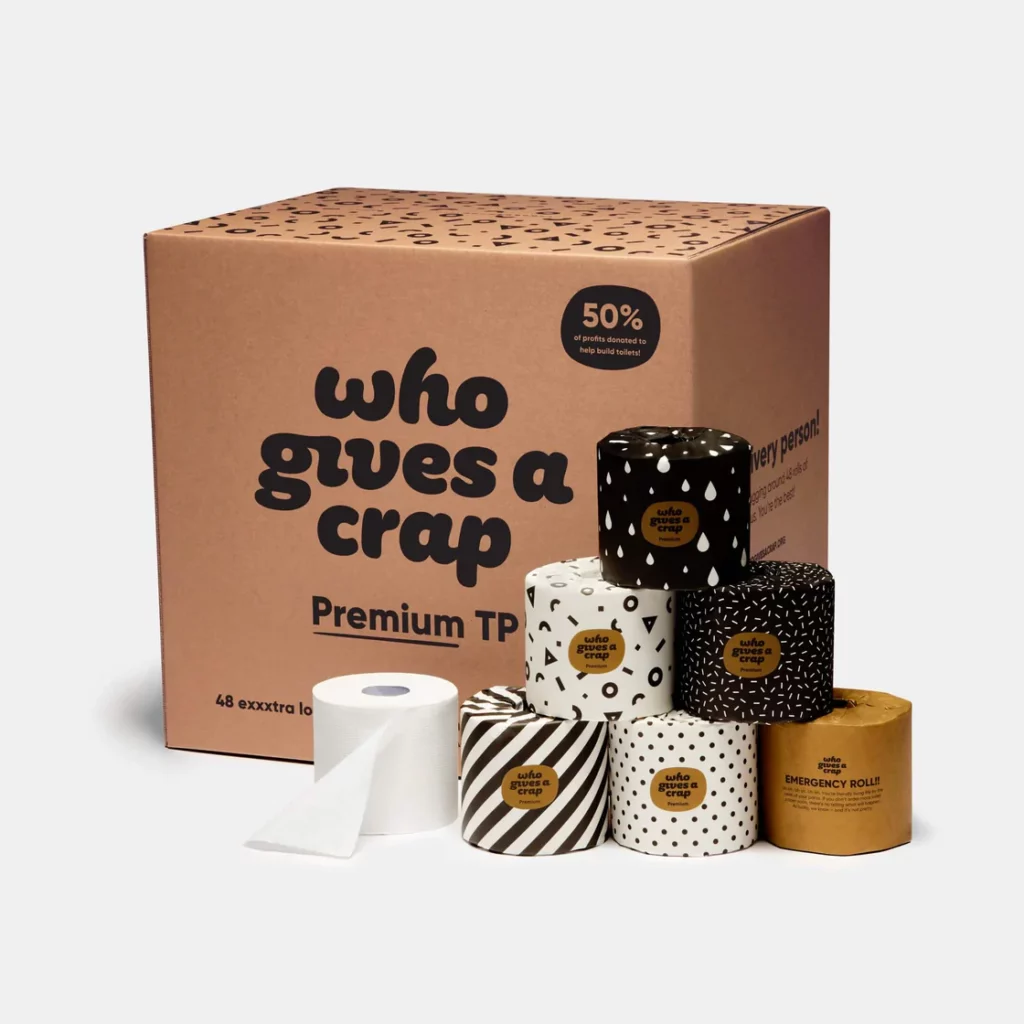
Who Gives A Crap, is a certified B Corp, meaning it takes this do good stuff super seriously. It donates 50 percent of its profits to clean water and sanitation efforts working to build toilets and bring clean water to everyone around the world by 2050. “We’re on a mission to uncrap the world,” the company says. And it’s making good on that promise with more than $11.2 million donated toward its goal to date. 
who gives a crap
Courtesy

We may take them for granted here in the U.S. but conveniences like running water and toilets are two of the biggest weapons in the fight against communicable diseases across the globe. (How’s this for a little irony: as conventional toilet paper brands contribute to deforestation and the global plastic waste problem, they also help to exacerbate climate change, which puts more people at risk of contagious diseases that both toilets and running water can help prevent.)

It’s all a lot to think about the next time you find yourself in the bathroom. And it’s why Who Gives A Crap says its purpose is to make it fun to do good. “The news surrounding the climate crisis can sometimes feel all doom and gloom,” the company says, “but with Happy TP, we wanted to show that you can make a more eco-conscious choice and still get a dopamine hit every time you go to the loo. After all, nothing says wipe that frown upside down like puppies and rainbows.”

Learn more and shop now on the Who Gives A Crap website.
Related on Ethos:

Related

The Case for Vegetables, Ottolenghi-Style

Yotam Ottolenghi’s cooking reframed vegetables as the center of the meal. His books and recipes pair bold spice, texture, and technique to make produce-driven dishes feel modern, generous, and deeply satisfying.

Flashback to Sustainable Fashion’s Early Circular Moves In 2016

As 2016 resurfaces in our feeds, we take a look at how sustainability wove through fashion that year — from recycled denim and water-saving techniques to early circular commitments from brands big and small.

How Wildflower Loss Shaped Stella McCartney’s SS26 Collection

Stella McCartney’s SS26 collection references Britain’s disappearing wildflower meadows through hand-embroidered tailoring, continuing the label’s long-standing practice of embedding environmental themes into design and materials.

How L’Oréal Is Testing Sustainable Innovation at Scale

L’Oréal has revealed the first cohort for L’AcceleratOR, its €100 million sustainable innovation program, selecting 13 companies focused on packaging, ingredients, circular systems, and emissions data. The group was chosen from nearly 1,000 applicants and represents the first pilot phase of the five-year initiative, which is designed to identify, test, and potentially scale sustainability-focused technologies across the company’s global operations and the wider beauty industry. https://www.loreal.com/en/press-release/sustainable-development/-l-oreal-announces-the-first-13-change-makers-chosen-to-join-its-eur-100-million-sustainable-innovation-l-accelerator-program/ Launched in 2024, L’AcceleratOR was created to move beyond concept-stage innovation and toward commercial deployment, with a particular emphasis on solutions that can be piloted within existing industrial systems. The program is operated in partnership with the University of Cambridge Institute for Sustainability Leadership, which is overseeing a structured support phase centered on pilot readiness and business integration. https://www.cisl.cam.ac.uk/ Rather than narrowing its scope to a single sustainability challenge, L’Oréal has positioned the accelerator around a broad set of operational priorities, including low-carbon materials and energy, nature-sourced ingredients, water resilience, the reduction of fossil-based plastics, circular manufacturing processes, and inclusive business models. The composition of the first cohort reflects that approach, with selected companies spanning physical materials, chemical inputs, waste transformation, and digital infrastructure. https://www.esgtoday.com/loreal-backs-13-climate-nature-and-circularity-solutions-startups/ Packaging, Materials, and the Push Away From Fossil Inputs Several of the selected companies focus on rethinking packaging formats that remain deeply embedded in beauty supply chains. United Kingdom-based Pulpex is developing recyclable paper bottles intended to replace rigid plastic packaging, while Japan’s Bioworks produces bioplastics derived from sugarcane and other plant-based feedstocks. Sweden’s Blue Ocean Closures and PULPAC are advancing fiber-based packaging systems designed to reduce both material complexity and carbon intensity, and Estonia’s RAIKU transforms natural wood into protective packaging alternatives traditionally made from petroleum-based foams. https://esgpost.com/loreal-selects-first-13-start-ups-for-laccelerator-sustainability-programme/ Ingredients and formulation inputs are also central to the cohort. France-based Biosynthis focuses on renewable and biodegradable raw materials, while U.S. company P2 Science applies green chemistry principles to develop bio-sourced fragrance and ingredient components. Another U.S. firm, Oberon Fuels, converts wood and pulp waste into renewable dimethyl ether suitable for aerosol formulations, addressing a category that has historically relied on fossil-derived propellants. https://esgpost.com/loreal-selects-first-13-start-ups-for-laccelerator-sustainability-programme/ Circular Systems and Measuring What Matters Circularity solutions appear throughout the cohort, including Belgium’s Novobiom, which uses fungi to break down complex waste streams into higher-value materials, and France’s REPLACE, which has developed a single-step process to convert multi-layer waste into new durable products. From Brazil, Gàs Verde contributes biomethane production technology aimed at reducing fossil fuel use in industrial energy and transport. https://esgpost.com/loreal-selects-first-13-start-ups-for-laccelerator-sustainability-programme/ The only data intelligence company selected, United Kingdom-based Neutreeno, focuses on supply-chain emissions measurement and reduction, reflecting the growing role of digital infrastructure in meeting climate targets and regulatory expectations. https://www.esgtoday.com/loreal-backs-13-climate-nature-and-circularity-solutions-startups/ The thirteen companies will now enter a CISL-led support phase focused on pilot readiness, with opportunities to run six- to nine-month pilots and, if successful, scale solutions across L’Oréal’s operations. Ezgi Barcenas, Chief Corporate Responsibility Officer at L’Oréal, described the approach as intentionally collaborative, saying, “To accelerate sustainable solutions to market, we are being even more intentional and inclusive in our pursuit of partnerships through L’AcceleratOR. We are really energized to be co-designing the future of beauty with CISL and these 13 change-makers.” https://www.esgtoday.com/loreal-backs-13-climate-nature-and-circularity-solutions-startups/ L’AcceleratOR sits within the company’s broader ten-year sustainability strategy, which includes goals to reach one hundred percent renewable energy, source at least ninety percent bio-based materials in formulas and packaging, reduce virgin plastic use by fifty percent, and significantly cut Scope One, Scope Two, and selected Scope Three emissions by 2030. https://www.loreal.com/en/commitments-and-responsibilities/

What Is Eco Brutalism? Is It the Beginning or the End of Sustainable Design?

Eco-brutalism is an architectural style gaining popularity for combining brutalist design elements with greenery to create a unique aesthetic and the perception that it is more sustainable than traditional brutalism. However, it has also faced criticism, particularly regarding its sustainability status.