
Sunday, January 18, 2026

Why Surf Legend Kelly Slater Wants You to Wear Sustainable Sandals and Think About the Moon

Share

Eleven-Time World Surfing Champion Kelly Slater has launched KLLY, a sandal company out to make sustainable footwear the norm.

Shoes aren’t likely the first thing that comes to mind when you think of Kelly Slater. Maybe it’s his 11 World Surfing Titles. Or his 55 total career victories. Maybe it’s that he was both the youngest and oldest World Champion in men’s surfing history.

Perhaps you think of Slater’s entrepreneurial side — he founded the popular eco apparel brand Outerknown in 2014. The Kelly Slater Wave Company launched in 2015, making viral-video-worthy man-made waves. He’s the visionary behind Firewire Surfboards, the most sustainable surfboard platform in the world. He also developed Slater Designs to showcase designs he created with legendary surfboard shapers as well as his latest addition to the product line, Endorfins — high-performance surfboard fins made with sustainable materials.

Or maybe you think of Slater’s charitable work. The surfing legend, now 51, has lent his name to a number of organizations and efforts including Omaze, Oceana, Surfrider, Surfers Not Street Children, Sea Shepherd, and Greenpeace among others.

kelly slater with surfboard
Kelly Slater was inspired by the moon’s relationship to the oceans for the new sandals. | Courtesy KLLY

But, now, the pro surfing great is keen to dominate in yet another category, with the launch of his first sustainable footwear range, KLLY.

“I drew a lot of inspiration from my personal life,” Slater told Ethos via email about the new sandals. “Having lived in sandals for the majority of my life, I designed them with my own needs in mind,” Slater says. “I knew I wanted them to be eco-conscious and to incorporate recycled materials, while at the same time prioritizing comfort and performance.”

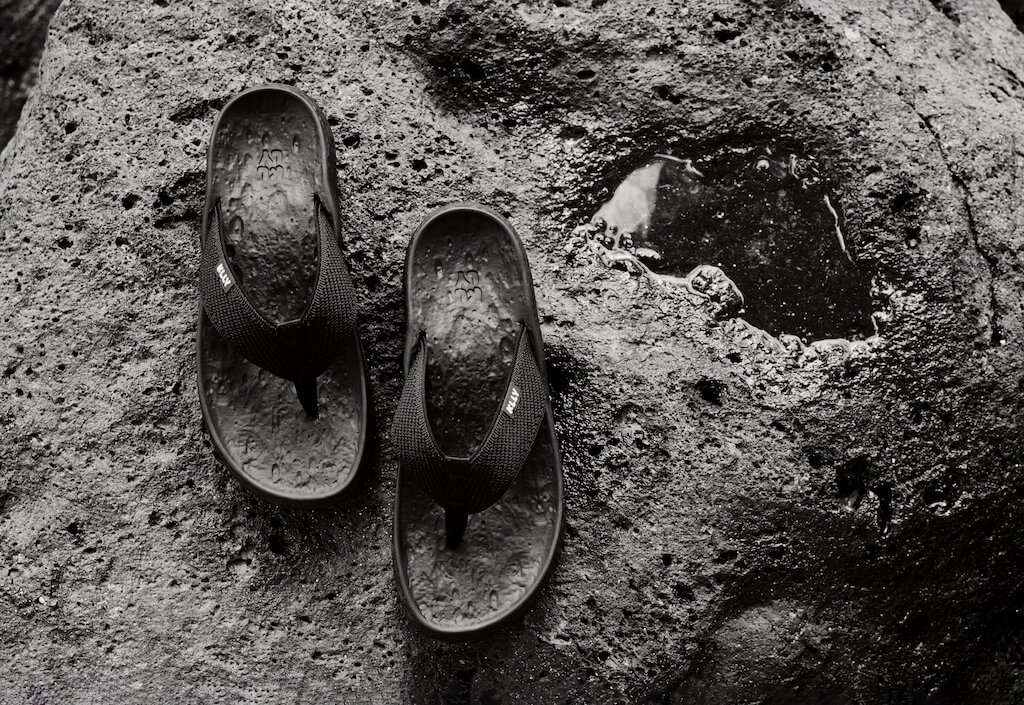
Slater says he designed KLLY’s first shoe, the KLLY Sandal, for superior comfort; the sole is a bit thicker than the flip flops you’re likely used to. That’s because these aren’t your average flip-flops. The KLLY sandals retail for $89.
KLLY sandals
The KLLY Sandals are made from recycled and sustainable materials. | Courtesy KLLY

Slater says the sandals have a “perfect arch” in order to create a comfortable footbed “that sustains the shape of the foot,” he says. “The added thickness also helps to elevate the footbed to avoid picking up too much sand while walking.”

The performance-based sandals are also made with the planet in mind. The KLLY Sandal is made from recycled material and BLOOM’s algae technology for shoes that provide superior cushioning and comfort while also being ethically produced.

I was deeply inspired by nature and the mysterious connection between sea turtles and the moon.

Kelly Slater

The type of BLOOM material KLLY uses in its sandal is called Rise (formerly known as Bloom Foam). “Rise is the environmentally-conscious, high-performance replacement for traditional petroleum-based EVAs,” says Slater. “Foams utilizing Bloom’s algae technology deliver striking performance values, which make them excellent replacements for conventional foams.”

The use of Rise was inspired by the effectiveness Slater saw in using the material in the traction pads for his eco-conscious surfboard company, Firewire Surfboards.

The KLLY sandal also uses some non-BLOOM sustainable materials including GRS-Certified rPET recycled content, EVA, rubber, recycled rubber, SBR foam, and elastane.

The first sandal in the KLLY line is available in the New Moon colorway — black with details resembling the surface of the moon.

“I was deeply inspired by nature and the mysterious connection between sea turtles and the moon,” Slater says. The surfer is a long-time environmentalist and advocate for wildlife preservation. “The top of the KLLY Sandal sole mirrors the moon’s surface while the bottom represents turtle scales.”

KLLY sandal sole
The KLLY Sandal is inspired by the scales of turtles. | Courtesy KLLY

Slater says he has always been captivated by the way the moon’s gravitational pull generates tides in the ocean, connecting the moon, the surf, and its sea creatures. Turtles in particular have a special connection to the moon, with 13 large scales that represent the 13 moons in each year and 28 smaller scales that represent the moon’s monthly cycle. The KLLY sandal is a tribute to these coexisting forces.

“I’ve spent a majority of my career chasing the perfect wave and in that time I’ve also been acutely aware of the impact that our actions have on the planet,” Slater said in a statement. “With KLLY, I wanted to create a performance-driven sandal that not only reflects my passion for surfing and the ocean’s influence on my life, but also embodies my commitment to protecting it.”

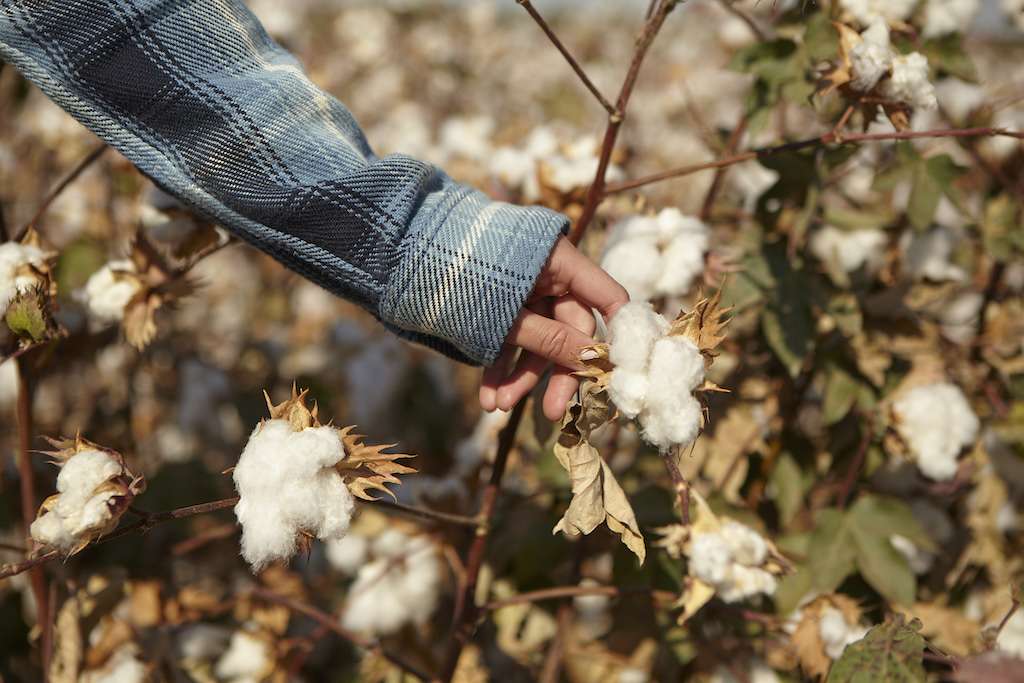
The KLLY launch comes on the heels of a milestone achievement for Outerknown, Slater’s popular apparel brand. Last month, the company achieved Regenerative Organic Certified (ROC) status — joining only four other brands to earn the mark for organic cotton from farms with the highest environmental standards. Regenerative agriculture is particularly focused on soil health.
organic cotton
Courtesy Outerknown

Outerknown’s current collection of ROC products includes several t-shirt styles with more to come, the brand says.

Earlier this week, Outerknown launched The California Series — a collection of heritage-inspired sweats made with 100 percent Climate Beneficial cotton, grown entirely in the heart of California’s Central Valley. The cotton comes from the California Cotton & Climate Coalition (C4). Outerknown is a founding brand partner of C4. The Fibershed-led project was started in 2020 to address the historic loss of carbon stocks in the California rangeland soil.

Related on Ethos:

Related

Levi’s Wants Students to Learn How to Repair Their Clothes

Levi Strauss & Co. has launched the Wear Longer Project, a nationwide education initiative developed to teach high school students clothing repair skills.

Your Favorite Oat Milk Brand Just Launched a Coffee-Themed Streetwear Collection

A new streetwear collaboration between Oatly and Kids of Immigrants puts some steam behind barista workwear.

How Wildflower Loss Shaped Stella McCartney’s SS26 Collection

Stella McCartney’s SS26 collection references Britain’s disappearing wildflower meadows through hand-embroidered tailoring, continuing the label’s long-standing practice of embedding environmental themes into design and materials.

Guerlain Partners With LVMH-Backed Circular Design Platform, Nona Source

Guerlain’s Spring 2026 Blooming Denim collection applies circular fashion sourcing to beauty packaging through a collaboration with LVMH's Nona Source.

How L’Oréal Is Testing Sustainable Innovation at Scale

L’Oréal has revealed the first cohort for L’AcceleratOR, its €100 million sustainable innovation program, selecting 13 companies focused on packaging, ingredients, circular systems, and emissions data. The group was chosen from nearly 1,000 applicants and represents the first pilot phase of the five-year initiative, which is designed to identify, test, and potentially scale sustainability-focused technologies across the company’s global operations and the wider beauty industry. https://www.loreal.com/en/press-release/sustainable-development/-l-oreal-announces-the-first-13-change-makers-chosen-to-join-its-eur-100-million-sustainable-innovation-l-accelerator-program/ Launched in 2024, L’AcceleratOR was created to move beyond concept-stage innovation and toward commercial deployment, with a particular emphasis on solutions that can be piloted within existing industrial systems. The program is operated in partnership with the University of Cambridge Institute for Sustainability Leadership, which is overseeing a structured support phase centered on pilot readiness and business integration. https://www.cisl.cam.ac.uk/ Rather than narrowing its scope to a single sustainability challenge, L’Oréal has positioned the accelerator around a broad set of operational priorities, including low-carbon materials and energy, nature-sourced ingredients, water resilience, the reduction of fossil-based plastics, circular manufacturing processes, and inclusive business models. The composition of the first cohort reflects that approach, with selected companies spanning physical materials, chemical inputs, waste transformation, and digital infrastructure. https://www.esgtoday.com/loreal-backs-13-climate-nature-and-circularity-solutions-startups/ Packaging, Materials, and the Push Away From Fossil Inputs Several of the selected companies focus on rethinking packaging formats that remain deeply embedded in beauty supply chains. United Kingdom-based Pulpex is developing recyclable paper bottles intended to replace rigid plastic packaging, while Japan’s Bioworks produces bioplastics derived from sugarcane and other plant-based feedstocks. Sweden’s Blue Ocean Closures and PULPAC are advancing fiber-based packaging systems designed to reduce both material complexity and carbon intensity, and Estonia’s RAIKU transforms natural wood into protective packaging alternatives traditionally made from petroleum-based foams. https://esgpost.com/loreal-selects-first-13-start-ups-for-laccelerator-sustainability-programme/ Ingredients and formulation inputs are also central to the cohort. France-based Biosynthis focuses on renewable and biodegradable raw materials, while U.S. company P2 Science applies green chemistry principles to develop bio-sourced fragrance and ingredient components. Another U.S. firm, Oberon Fuels, converts wood and pulp waste into renewable dimethyl ether suitable for aerosol formulations, addressing a category that has historically relied on fossil-derived propellants. https://esgpost.com/loreal-selects-first-13-start-ups-for-laccelerator-sustainability-programme/ Circular Systems and Measuring What Matters Circularity solutions appear throughout the cohort, including Belgium’s Novobiom, which uses fungi to break down complex waste streams into higher-value materials, and France’s REPLACE, which has developed a single-step process to convert multi-layer waste into new durable products. From Brazil, Gàs Verde contributes biomethane production technology aimed at reducing fossil fuel use in industrial energy and transport. https://esgpost.com/loreal-selects-first-13-start-ups-for-laccelerator-sustainability-programme/ The only data intelligence company selected, United Kingdom-based Neutreeno, focuses on supply-chain emissions measurement and reduction, reflecting the growing role of digital infrastructure in meeting climate targets and regulatory expectations. https://www.esgtoday.com/loreal-backs-13-climate-nature-and-circularity-solutions-startups/ The thirteen companies will now enter a CISL-led support phase focused on pilot readiness, with opportunities to run six- to nine-month pilots and, if successful, scale solutions across L’Oréal’s operations. Ezgi Barcenas, Chief Corporate Responsibility Officer at L’Oréal, described the approach as intentionally collaborative, saying, “To accelerate sustainable solutions to market, we are being even more intentional and inclusive in our pursuit of partnerships through L’AcceleratOR. We are really energized to be co-designing the future of beauty with CISL and these 13 change-makers.” https://www.esgtoday.com/loreal-backs-13-climate-nature-and-circularity-solutions-startups/ L’AcceleratOR sits within the company’s broader ten-year sustainability strategy, which includes goals to reach one hundred percent renewable energy, source at least ninety percent bio-based materials in formulas and packaging, reduce virgin plastic use by fifty percent, and significantly cut Scope One, Scope Two, and selected Scope Three emissions by 2030. https://www.loreal.com/en/commitments-and-responsibilities/