
Tuesday, January 20, 2026

‘Cheers’ Stars Reunite for Ocean Conservation: ‘Climate Change Can Undo Literally Everything’

Share

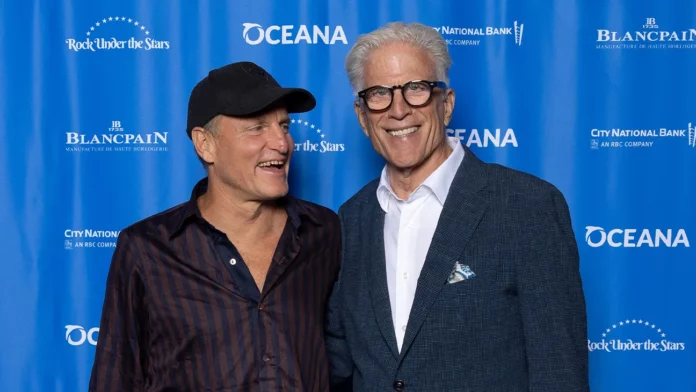
Celebrities came out to support ocean conservation organization Oceana at its fifth Rock Under the Stars event last Saturday.

While Hollywood continues to try and stay afloat amid the concurrent Writers Guild and Screen Actors Guild strikes, there was no shortage of star power at Oceana’s fifth Rock Under the Stars event hosted at the Los Angeles residence of Oceana board president Keith Addis and his wife Keri Selig.

Celebrities including Cheers co-stars Ted Danson and Woody Harrelson, Gladys Knight, Mary Steenburgen, and Sam Waterston, came out to support the event.

Before the festivities began, Addis addressed the crowd, emphasizing the urgent challenges facing both the oceans and the planet. “This is a challenging time for oceans and it’s a very challenging time for the planet,” he said. “You don’t have to look far to find out what’s happening with the fires, the terrible tragedy in Lahaina; everywhere you look, the 100 degree water in the Caribbean. It’s all hands on deck now.”

The evening’s agenda of urgent ocean conservation and climate action was underscored by the devastating fires in Maui last week.
ocean
Photo courtesy Motoki Tonn

Danson, a long-standing member of the Oceana board and an advocate for ocean conservation for more than four decades, spoke passionately about the urgent need for action.

“We do what we do because things are going to be getting worse and worse,” Danson told The Hollywood Reporter.

“One of the reasons we keep doing what we’re doing is with climate change, the waters are heating, the fish are swimming north, corals are dying,” he said. “Climate change can undo literally everything — 100 degrees off of Florida [this summer]. We’re here, this is not a warning.”

Danson was moved to start supporting Oceana during his early years on the sitcom Cheers.

“I was being paid a lot of money and I thought, ‘I need to be responsible in some way,’” he said. In the years since Danson first lent his support, Oceana has protected nearly four million square miles of ocean. It takes on threats including overfishing, plastic pollution, and habitat loss.

“The more you learn, the more you realize what’s at stake and that it is solvable, but it’s a heavy lift unless we all do it together,” Danson said.

ocean sanctuaries
Photo courtesy Ishan

“This is my two cents — it almost feels like yes, let’s keep fighting climate change, obviously, but I’m tired. I don’t want to convince anybody anymore who doesn’t believe in it,” Danson said. “I will have a conversation with them that goes like, ‘All right, forget what you call it, how can we help you when your neighborhood floods? What do we do now, because this is going to be happening, whether you believe it or not. How do we help you with your forest fires and your drought? How do we mitigate what’s already happening?'” Danson emphasized that the fight to protect the oceans is solvable, but it requires collective effort.

Waterston, the board chair of Oceana, also spoke at the event, urging attendees to take immediate action. “The message of the weather that we’ve all been having is hurry up; it’s not give up, it’s hurry up,” he said. “And what Oceana has developed is a method and a strategy to get practical results one after another after another, pile them on top of each other after 20 years, and lo and behold, you’ve made a gigantic change in what is 70 percent of the earth’s surface and therefore you’ve made a gigantic change for life in general.”

Danson’s sentiment was not without hope, though. He said, “I don’t have hope that it’s going to be a rosy reversal and all of that. I think there’s some very serious consequences of us not paying attention as a world are upon us. You always have to have hope — what are you doing to do, sit around and be pessimistic until you die? No, you be hopeful, you be helpful, you try to nurture and educate people, and do the best you can.”

Related on Ethos:

Related

Why ‘Secondhand First’ Is Becoming Fashion’s Most Defining Rule

Secondhand is no longer second best. Fashion lovers everywhere are choosing resale first as a practice for saving money, curating cooler wardrobes, and reshaping the industry as they go.

Flashback to Sustainable Fashion’s Early Circular Moves In 2016

As 2016 resurfaces in our feeds, we take a look at how sustainability wove through fashion that year — from recycled denim and water-saving techniques to early circular commitments from brands big and small.

How Wildflower Loss Shaped Stella McCartney’s SS26 Collection

Stella McCartney’s SS26 collection references Britain’s disappearing wildflower meadows through hand-embroidered tailoring, continuing the label’s long-standing practice of embedding environmental themes into design and materials.

How L’Oréal Is Testing Sustainable Innovation at Scale

L’Oréal has revealed the first cohort for L’AcceleratOR, its €100 million sustainable innovation program, selecting 13 companies focused on packaging, ingredients, circular systems, and emissions data. The group was chosen from nearly 1,000 applicants and represents the first pilot phase of the five-year initiative, which is designed to identify, test, and potentially scale sustainability-focused technologies across the company’s global operations and the wider beauty industry. https://www.loreal.com/en/press-release/sustainable-development/-l-oreal-announces-the-first-13-change-makers-chosen-to-join-its-eur-100-million-sustainable-innovation-l-accelerator-program/ Launched in 2024, L’AcceleratOR was created to move beyond concept-stage innovation and toward commercial deployment, with a particular emphasis on solutions that can be piloted within existing industrial systems. The program is operated in partnership with the University of Cambridge Institute for Sustainability Leadership, which is overseeing a structured support phase centered on pilot readiness and business integration. https://www.cisl.cam.ac.uk/ Rather than narrowing its scope to a single sustainability challenge, L’Oréal has positioned the accelerator around a broad set of operational priorities, including low-carbon materials and energy, nature-sourced ingredients, water resilience, the reduction of fossil-based plastics, circular manufacturing processes, and inclusive business models. The composition of the first cohort reflects that approach, with selected companies spanning physical materials, chemical inputs, waste transformation, and digital infrastructure. https://www.esgtoday.com/loreal-backs-13-climate-nature-and-circularity-solutions-startups/ Packaging, Materials, and the Push Away From Fossil Inputs Several of the selected companies focus on rethinking packaging formats that remain deeply embedded in beauty supply chains. United Kingdom-based Pulpex is developing recyclable paper bottles intended to replace rigid plastic packaging, while Japan’s Bioworks produces bioplastics derived from sugarcane and other plant-based feedstocks. Sweden’s Blue Ocean Closures and PULPAC are advancing fiber-based packaging systems designed to reduce both material complexity and carbon intensity, and Estonia’s RAIKU transforms natural wood into protective packaging alternatives traditionally made from petroleum-based foams. https://esgpost.com/loreal-selects-first-13-start-ups-for-laccelerator-sustainability-programme/ Ingredients and formulation inputs are also central to the cohort. France-based Biosynthis focuses on renewable and biodegradable raw materials, while U.S. company P2 Science applies green chemistry principles to develop bio-sourced fragrance and ingredient components. Another U.S. firm, Oberon Fuels, converts wood and pulp waste into renewable dimethyl ether suitable for aerosol formulations, addressing a category that has historically relied on fossil-derived propellants. https://esgpost.com/loreal-selects-first-13-start-ups-for-laccelerator-sustainability-programme/ Circular Systems and Measuring What Matters Circularity solutions appear throughout the cohort, including Belgium’s Novobiom, which uses fungi to break down complex waste streams into higher-value materials, and France’s REPLACE, which has developed a single-step process to convert multi-layer waste into new durable products. From Brazil, Gàs Verde contributes biomethane production technology aimed at reducing fossil fuel use in industrial energy and transport. https://esgpost.com/loreal-selects-first-13-start-ups-for-laccelerator-sustainability-programme/ The only data intelligence company selected, United Kingdom-based Neutreeno, focuses on supply-chain emissions measurement and reduction, reflecting the growing role of digital infrastructure in meeting climate targets and regulatory expectations. https://www.esgtoday.com/loreal-backs-13-climate-nature-and-circularity-solutions-startups/ The thirteen companies will now enter a CISL-led support phase focused on pilot readiness, with opportunities to run six- to nine-month pilots and, if successful, scale solutions across L’Oréal’s operations. Ezgi Barcenas, Chief Corporate Responsibility Officer at L’Oréal, described the approach as intentionally collaborative, saying, “To accelerate sustainable solutions to market, we are being even more intentional and inclusive in our pursuit of partnerships through L’AcceleratOR. We are really energized to be co-designing the future of beauty with CISL and these 13 change-makers.” https://www.esgtoday.com/loreal-backs-13-climate-nature-and-circularity-solutions-startups/ L’AcceleratOR sits within the company’s broader ten-year sustainability strategy, which includes goals to reach one hundred percent renewable energy, source at least ninety percent bio-based materials in formulas and packaging, reduce virgin plastic use by fifty percent, and significantly cut Scope One, Scope Two, and selected Scope Three emissions by 2030. https://www.loreal.com/en/commitments-and-responsibilities/

What Is Eco Brutalism? Is It the Beginning or the End of Sustainable Design?

Eco-brutalism is an architectural style gaining popularity for combining brutalist design elements with greenery to create a unique aesthetic and the perception that it is more sustainable than traditional brutalism. However, it has also faced criticism, particularly regarding its sustainability status.