
Tuesday, January 20, 2026

Natural Toothpastes That Are Gentler On the Planet and Your Mouth

Share

Natural toothpaste brands are becoming more eco-friendly, offering pastes, powders, and even tablets, to help you get that gorgeous, healthy smile. But are they as good at protecting your teeth from cavities?


“The oral-care aisle can often feel like a homework assignment, especially when it comes to decoding the natural options. Tubes feature botanical illustrations, promises of instant whitening, and even claims that fluoride-free formulas are better for you and the planet—confusing, if not completely exhausting. But when oral health needs go beyond brightening, like cavity prevention or gum disease treatment, the question becomes more complex: does a natural toothpaste have to forego fluoride? And, critically, should it?”

Fluoride is not a synthetic contaminant but a naturally occurring mineral found in soil, water and certain foods. When used at recommended levels, it strengthens tooth enamel and helps reverse early decay. The American Dental Association points out that fluoride toothpaste reduces the risk of cavities by 25 percent in both children and adults, and the Centers for Disease Control and Prevention note that community water fluoridation lowers cavity rates by roughly 25 percent. Fluoride works before teeth erupt and after, remineralizing enamel; it is safe when used properly, which makes the fear around it more myth than reality.

Still, many consumers are drawn to fluoride‑free toothpastes because of their natural ingredients. These products often rely on xylitol, a plant‑based sweetener that disrupts energy production in cavity‑causing bacteria. Hydroxyapatite, the mineral that forms the bulk of tooth enamel, is another popular addition. Yet the evidence supporting these alternatives is limited. Research shows that xylitol toothpaste does not outperform fluoride, and hydroxyapatite and nanohydroxyapatite have not been approved by the U.S. Food and Drug Administration. Fluoride, on the other hand, has been regarded as “one of the great public health achievements” for its ability to prevent demineralization, help minerals return to enamel and inhibit bacteria.

Environmental concerns also influence toothpaste purchasing decisions. Many natural toothpaste brands emphasise eco‑friendly credentials, yet the biggest environmental impact often comes from packaging rather than ingredients. Most conventional toothpaste tubes are made from layers of plastic and aluminium, making them difficult to recycle. Globally, around 1.5 billion tubes are thrown away each year; in the United Kingdom alone, 300 million go to landfill, and each tube can take centuries to break down. These tubes are hard to recycle.

Microplastics are another issue. The U.S. Microbead‑Free Waters Act banned plastic microbeads in rinse‑off personal care items such as toothpaste, and the European Union enacted similar restrictions with a transition period through 2027. These particles escape wastewater treatment and accumulate in rivers and oceans. Choosing a fluoride‑free formula does not address these environmental challenges; look instead for recyclable tubes, refillable containers or toothpaste tablets and powders.

Making an informed choice involves separating marketing from science. Fluoride is a naturally occurring mineral with decades of evidence behind it. Alternatives like xylitol and hydroxyapatite may support enamel but should not replace fluoride, especially for children. To reduce your environmental footprint, prioritise recyclable or reusable packaging and avoid abrasive ingredients like charcoal or pure baking soda, which can erode enamel. Choosing toothpaste becomes easier when you look beyond slogans: natural isn’t always more eco‑friendly, and fluoride isn’t an industrial toxin but a mineral that protects your teeth.

What about the toothbrush?

Your dentist will tell you your toothbrush choice matters — a lot. While the disposable kind work in a pinch or when you’re traveling (there are eco-bamboo and recycled plastic options for those occasions), experts recommend going electric. Not only do electric toothbrushes do much of the work for you, but they do it better. Dentists love the Oral-B electric brushes, or try Moon for a chic ergonomic design and a range of settings. But it’s hard to go wrong with any of them.

On the note of electrifying your brushing, you can electrify your flossing, too, with a Waterpik. It can be more effective than conventional flossing, which many dentists will tell you is more important than brushing anyway.

Eco-friendly natural toothpaste brands

What makes a toothpaste brand eco-friendly? There’s no one catch-all definition, but a few things make a difference — from ingredients to packaging. The same goes for natural: the cleaner the ingredients, the more natural it is, even though there’s no formal definition for “natural.” Zero-waste toothpaste brands like the few tablets on this list are a great place to start your journey to sustainable toothpaste. Give these brands a try.
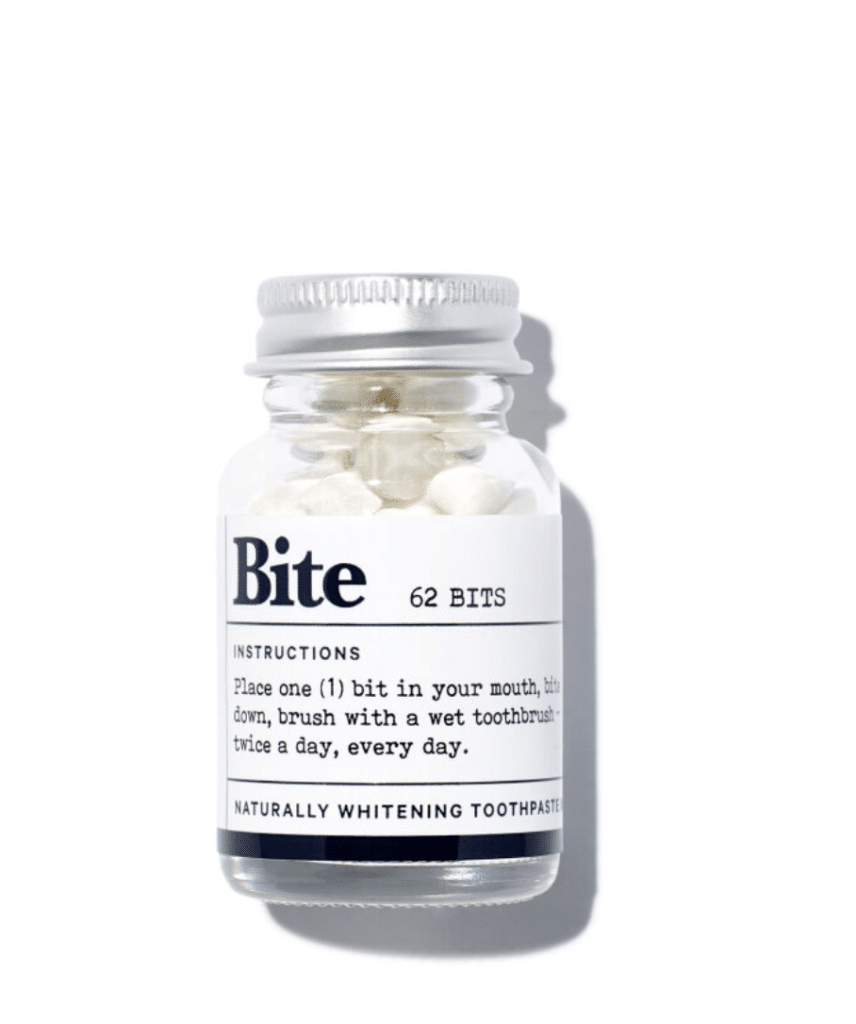
Bite

Bite promises to keep your pearly whites pristine with its vegan, cruelty-free and eco-friendly toothpaste bits. Packaged in a recyclable glass jar, these ‘bits’ are simply natural toothpaste tabs and they’re super easy to use. Just pop one in your mouth, bite down, and brush (also make sure to wet your toothbrush to get the best results).

One jar contains enough toothpaste bits to keep you going for 4 months. At $30 a jar, that’s about 25 cents per day. Plus, after your supply is used up Bite will deliver a refill in compostable packaging through the easy subscription service.

Not sure it’s a fit? Try them out on a trial basis at just $12, with the smaller bottle containing enough bits to last you for around a month.

Why we love it: The convenience can’t be beat and the natural ingredients deliver fresh breath and keep teeth naturally white without harsh chemicals.

Tom’s of Maine

Tom’s Whole Care Fluoridated Toothpaste offers a straightforward way to protect your smile with a formula that’s both effective and responsibly made. Crafted with fluoride to help prevent cavities and strengthen enamel, it also contains natural ingredients like zinc citrate for tartar control and xylitol for a burst of freshness. The toothpaste is free from artificial flavors, colors, or preservatives.

A standard tube lasts for months with twice-daily brushing, making it an affordable choice for maintaining oral health.

Why we love it: It delivers the cavity-fighting benefits of fluoride with naturally derived ingredients, all in eco-conscious packaging you can feel good about using every day.

Tom's toothpaste.

Huppy

Like Bite, Huppy has also jumped on the toothpaste tablet train. Its tabs are completely plastic-free, non-GMO, cruelty-free and, it should be noted, extra minty. On top of that, they’re also super simple to use. Just pop one in your mouth, chew, and brush twice a day.

You can either buy a four-month’s supply or try these eco-friendly toothpaste tabs on a trial basis. When you purchase, you’ll also be provided with a plastic-free Huppy container, and every refill is packaged using compostable materials.

In case you needed any more convincing, Huppy has also been given the seal of approval from Women’s Health and the Self Healthy Beauty Awards.

Why we love it: Another super easy travel option with exceptional flavor and nice foaming action. Not for the peppermint averse!

Georganics

Whatever kind of dental product you’re looking for, Georganics have got it. From toothpaste tabs and pastes to plastic-free floss and mouthwash, as well as mineral toothpaste powder. You’ll find them in a range of flavors ranging from your standard peppermint to charcoal.

All are cruelty-free and vegan, flavored with organic oils that naturally remove stains and whiten teeth. To use, simply dip your toothbrush into the recyclable glass jar to coat with powder, and then brush as normal.

Why we love it: The powder or the tablets offer you an easy way to brush. The spearmint flavor isn’t overpowering, either.

Davids

Founded in 2011, Davids is an old hand when it comes to producing top-quality eco-friendly dental products. One of the few pre-formulated kinds of toothpaste on the sustainable market, all of  Davids products come in recyclable metal tubes which are not only better for the planet, but much easier to squeeze than classic plastic tubes.

The brand’s vegan toothpastes are fluoride and SLS-free, and 98 percent of ingredients are sourced in the U.S., where the company is based, thus saving on further carbon emissions.

Why we love it: Davids gives classic toothpaste a modern makeover with a fully recyclable metal tube and old-fashioned minty paste inside. So good you’ll never forget to brush!

Hello

Hello makes a range of oral care products that are friendlier for you, and for the planet. The brand is committed to making everything in its portfolio vegan, cruelty-free, and sustainable. It uses plant-based, natural ingredients such as aloe vera, bamboo, coconut oil, palm oil, stevia, and mint, and never tests on animals.

“Brushing. Rinsing. Smiling. It’s all good. But you know what’s not so good? Testing products on animals or adding in animal-derived ingredients where they aren’t needed,” the company says on its website. “We’re all part of this planet, so it’s important that consumer products—including oral care ones—are good to our bodies, our furry friends, and the environment.”

Why we love it: Charcoal toothpaste brightens your smile but some can taste a bit like … charcoal. Hello delivers the benefits in a natural, vegan minty paste that tastes great.

hello toothpaste

Risewell

Risewell is carving out a unique space in the toothpaste market using a natural form of hydroxyapatite. The whitening and anti-cavity mineral is ethically sourced from a mine in France. Risewell says it has visited every single supplier to know exactly where it came from. The company boasts what it says is the highest quality hydroxyapatite in the world.

Beyond its hero ingredient, Risewell uses all-natural plant-based ingredients for a great-tasting toothpaste that’ll leave you smiling in more ways than one.

Why we love it: Risewell’s unique mineral base is also uniquely traceable, which we love. It also delivers a brighter smile and fresh, minty breath that lasts.

Canary

For a fresh and lasting clean that doesn’t stain the planet, Canary offers a convenient option. No more plastic waste, no more wasted toothpaste bits in the tube — Canary ensures a plastic-free and travel-friendly brushing every time.

No aspartame, gluten, parabens, or sulfates. The subscription model lets you reuse your glass jar with refillable pouches coming every four months — adding extra convenience to your daily oral hygiene habits.

Why we love it: The vegan tablets are made in the U.S., and come in fresh flavors like peppermint, wintergreen, strawberry-kiwi, and watermelon — all without being too intense.

Canary toothpaste tablets

Related on Ethos:

All products featured on Ethos have been independently selected by our editorial team.
When you buy something through our links, Ethos may earn an affiliate commission.

Related

How The Ordinary Stacks Up to Higher-Priced Luxury Skincare

The Ordinary has reshaped everyday skincare through ingredient transparency, accessible pricing, and routine-ready formulas. Here’s how the brand’s core products work, how they compare to higher-end alternatives, and where they fit in an evidence-based daily regimen.

How to Take the Best Bath: Clean Soaking Products That Bring Big Benefits

Boost your bath season with clean bath products — from mineral salts and oils to foams and soaks. Plus, how to choose the right add-in based on what you actually need.

With Henry Rose’s London 1983, Michelle Pfeiffer Might Finally Make You a Clean Fragrance Convert

Michelle Pfeiffer’s Henry Rose debuts London 1983, a fig-and-musk fragrance that aligns more closely with classic luxury perfumery than its clean fragrance category.

How L’Oréal Is Testing Sustainable Innovation at Scale

L’Oréal has revealed the first cohort for L’AcceleratOR, its €100 million sustainable innovation program, selecting 13 companies focused on packaging, ingredients, circular systems, and emissions data. The group was chosen from nearly 1,000 applicants and represents the first pilot phase of the five-year initiative, which is designed to identify, test, and potentially scale sustainability-focused technologies across the company’s global operations and the wider beauty industry. https://www.loreal.com/en/press-release/sustainable-development/-l-oreal-announces-the-first-13-change-makers-chosen-to-join-its-eur-100-million-sustainable-innovation-l-accelerator-program/ Launched in 2024, L’AcceleratOR was created to move beyond concept-stage innovation and toward commercial deployment, with a particular emphasis on solutions that can be piloted within existing industrial systems. The program is operated in partnership with the University of Cambridge Institute for Sustainability Leadership, which is overseeing a structured support phase centered on pilot readiness and business integration. https://www.cisl.cam.ac.uk/ Rather than narrowing its scope to a single sustainability challenge, L’Oréal has positioned the accelerator around a broad set of operational priorities, including low-carbon materials and energy, nature-sourced ingredients, water resilience, the reduction of fossil-based plastics, circular manufacturing processes, and inclusive business models. The composition of the first cohort reflects that approach, with selected companies spanning physical materials, chemical inputs, waste transformation, and digital infrastructure. https://www.esgtoday.com/loreal-backs-13-climate-nature-and-circularity-solutions-startups/ Packaging, Materials, and the Push Away From Fossil Inputs Several of the selected companies focus on rethinking packaging formats that remain deeply embedded in beauty supply chains. United Kingdom-based Pulpex is developing recyclable paper bottles intended to replace rigid plastic packaging, while Japan’s Bioworks produces bioplastics derived from sugarcane and other plant-based feedstocks. Sweden’s Blue Ocean Closures and PULPAC are advancing fiber-based packaging systems designed to reduce both material complexity and carbon intensity, and Estonia’s RAIKU transforms natural wood into protective packaging alternatives traditionally made from petroleum-based foams. https://esgpost.com/loreal-selects-first-13-start-ups-for-laccelerator-sustainability-programme/ Ingredients and formulation inputs are also central to the cohort. France-based Biosynthis focuses on renewable and biodegradable raw materials, while U.S. company P2 Science applies green chemistry principles to develop bio-sourced fragrance and ingredient components. Another U.S. firm, Oberon Fuels, converts wood and pulp waste into renewable dimethyl ether suitable for aerosol formulations, addressing a category that has historically relied on fossil-derived propellants. https://esgpost.com/loreal-selects-first-13-start-ups-for-laccelerator-sustainability-programme/ Circular Systems and Measuring What Matters Circularity solutions appear throughout the cohort, including Belgium’s Novobiom, which uses fungi to break down complex waste streams into higher-value materials, and France’s REPLACE, which has developed a single-step process to convert multi-layer waste into new durable products. From Brazil, Gàs Verde contributes biomethane production technology aimed at reducing fossil fuel use in industrial energy and transport. https://esgpost.com/loreal-selects-first-13-start-ups-for-laccelerator-sustainability-programme/ The only data intelligence company selected, United Kingdom-based Neutreeno, focuses on supply-chain emissions measurement and reduction, reflecting the growing role of digital infrastructure in meeting climate targets and regulatory expectations. https://www.esgtoday.com/loreal-backs-13-climate-nature-and-circularity-solutions-startups/ The thirteen companies will now enter a CISL-led support phase focused on pilot readiness, with opportunities to run six- to nine-month pilots and, if successful, scale solutions across L’Oréal’s operations. Ezgi Barcenas, Chief Corporate Responsibility Officer at L’Oréal, described the approach as intentionally collaborative, saying, “To accelerate sustainable solutions to market, we are being even more intentional and inclusive in our pursuit of partnerships through L’AcceleratOR. We are really energized to be co-designing the future of beauty with CISL and these 13 change-makers.” https://www.esgtoday.com/loreal-backs-13-climate-nature-and-circularity-solutions-startups/ L’AcceleratOR sits within the company’s broader ten-year sustainability strategy, which includes goals to reach one hundred percent renewable energy, source at least ninety percent bio-based materials in formulas and packaging, reduce virgin plastic use by fifty percent, and significantly cut Scope One, Scope Two, and selected Scope Three emissions by 2030. https://www.loreal.com/en/commitments-and-responsibilities/

Maison Louis Marie Introduces Its First Vanilla Fragrance, No. 15 Vanille Infinie

Maison Louis Marie introduces No.15 Vanille Infinie, bringing vanilla into its clean fragrance collection for the first time.